
Features
Everything editors and authors need, from submission to decision.
One workspace for law reviews and the authors who submit to them, connected to HeinOnline’s Law Journal Library. Free for every journal.
01 · Manage the season
A clear view of every cycle.
From the moment a cycle opens to the day it closes, every submission has a place, a status and an owner.
Submission cycles
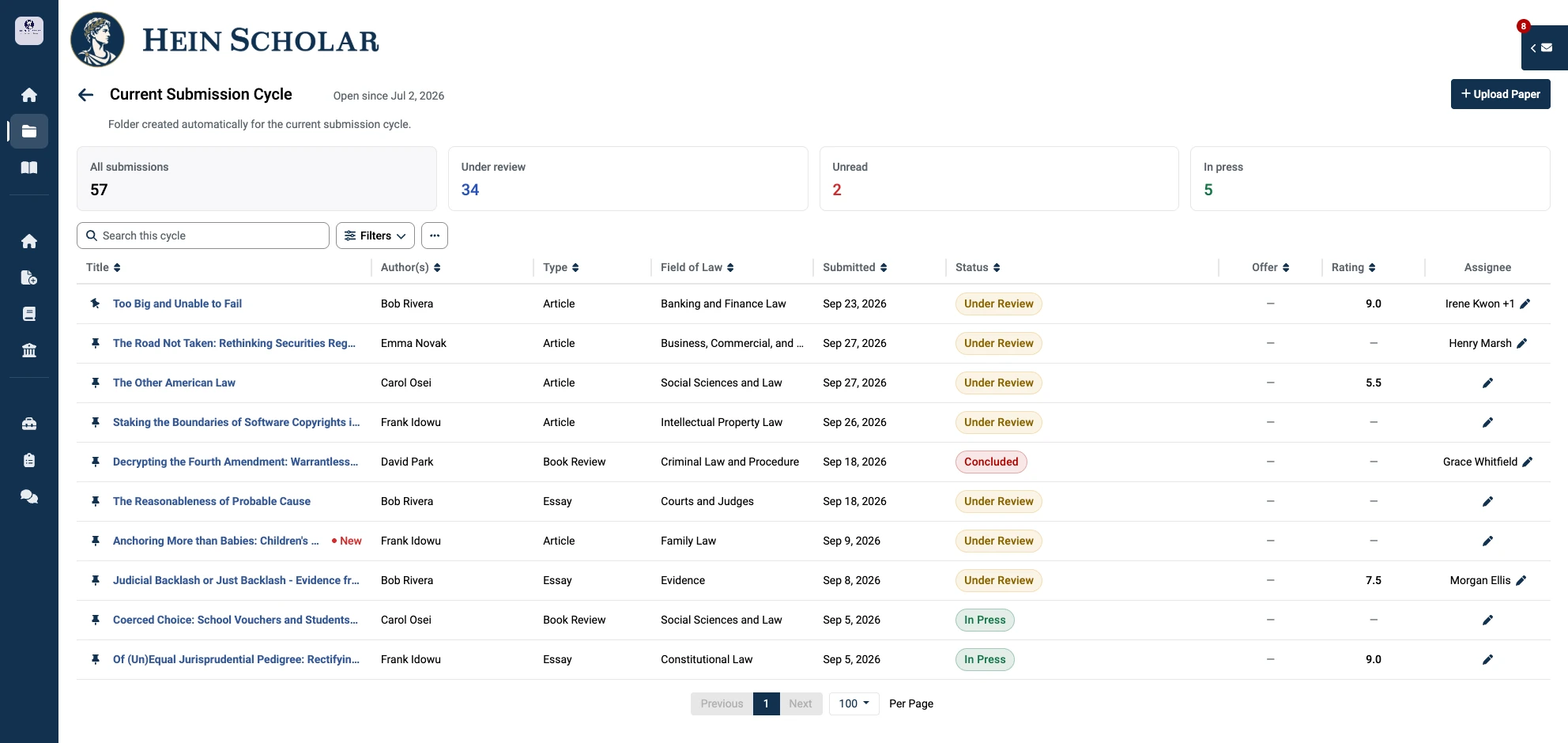
Each cycle gets its own folder, opened and closed with your journal, so a new season never buries the last.
Sort, filter and search
Sort by status, field of law, type, rating or editor, and search across the whole cycle.
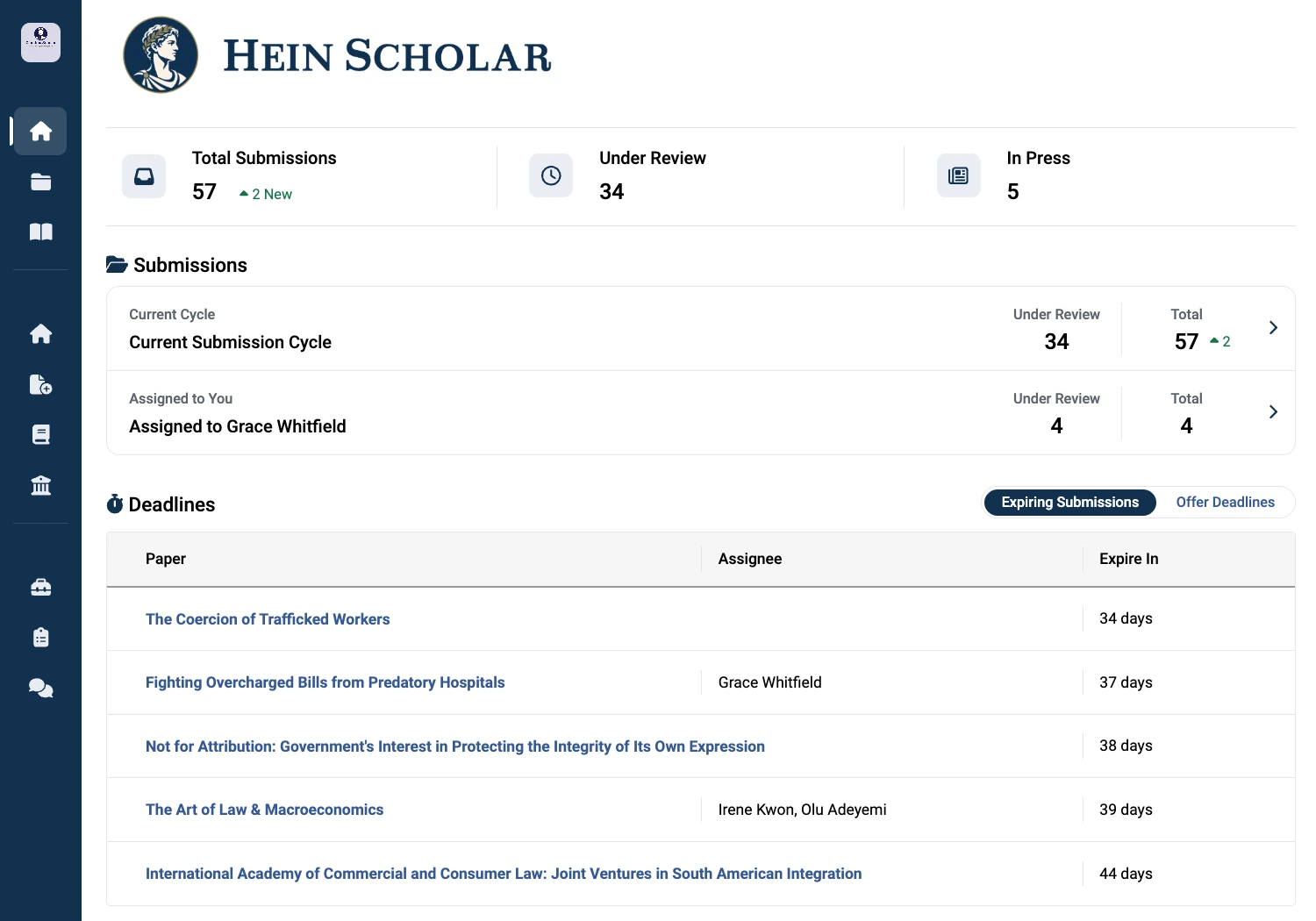
Your dashboard
Totals, new arrivals, papers under review and papers in press, the moment you sign in.
Deadlines in one list
Expiring submissions and offer deadlines side by side, so nothing lapses unnoticed.
02 · Evaluate
Read, check and discuss every manuscript in one place.
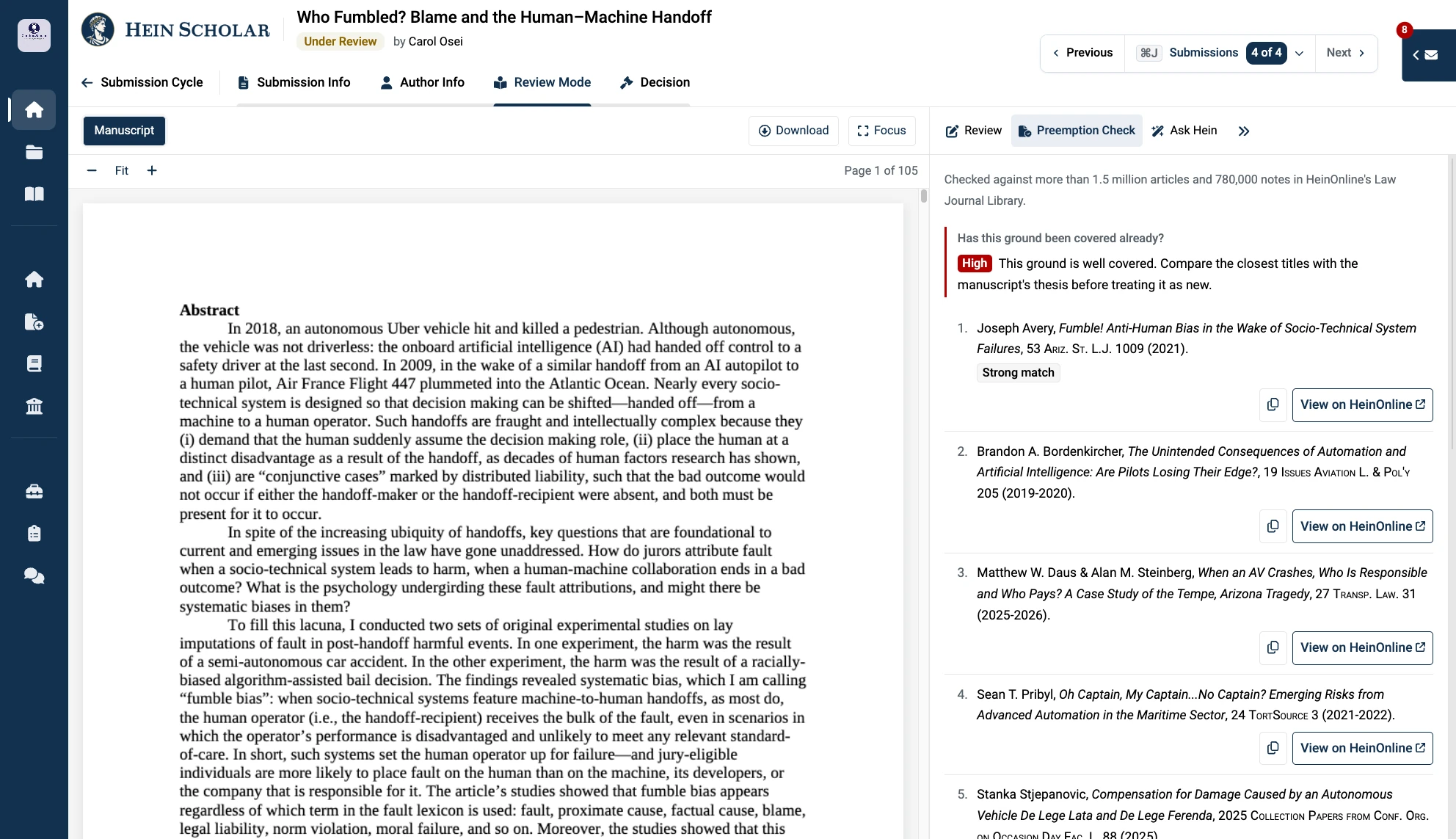
Review Mode puts the manuscript beside everything you need to judge it, from the preemption result to your board’s notes.
Review Mode
Read the manuscript and evaluate it side by side in the browser. No downloads, no attachments.
Preemption Check
Checked against more than 1.5 million articles and 780,000 notes, with a coverage rating and the closest published titles.
Summaries and keywords
Each submission arrives with an AI summary, subject keywords and word counts for text and footnotes.
Ask Hein
Ask questions about a manuscript in plain language and get answers drawn from the text.
Ratings and annotations
Score each piece, annotate passages and keep notes with the article for the whole board.
Team discussion
Talk a submission through with fellow editors in a thread attached to the paper.
03 · Decide and remember
Decisions that carry forward to next year’s board.
Offers and declines
Send an offer or decline from the Decision tab. The author is notified and can accept or decline.
Every journal’s decision
See what each journal on Hein Scholar has decided on a paper, the best offer and the next offer expiration.
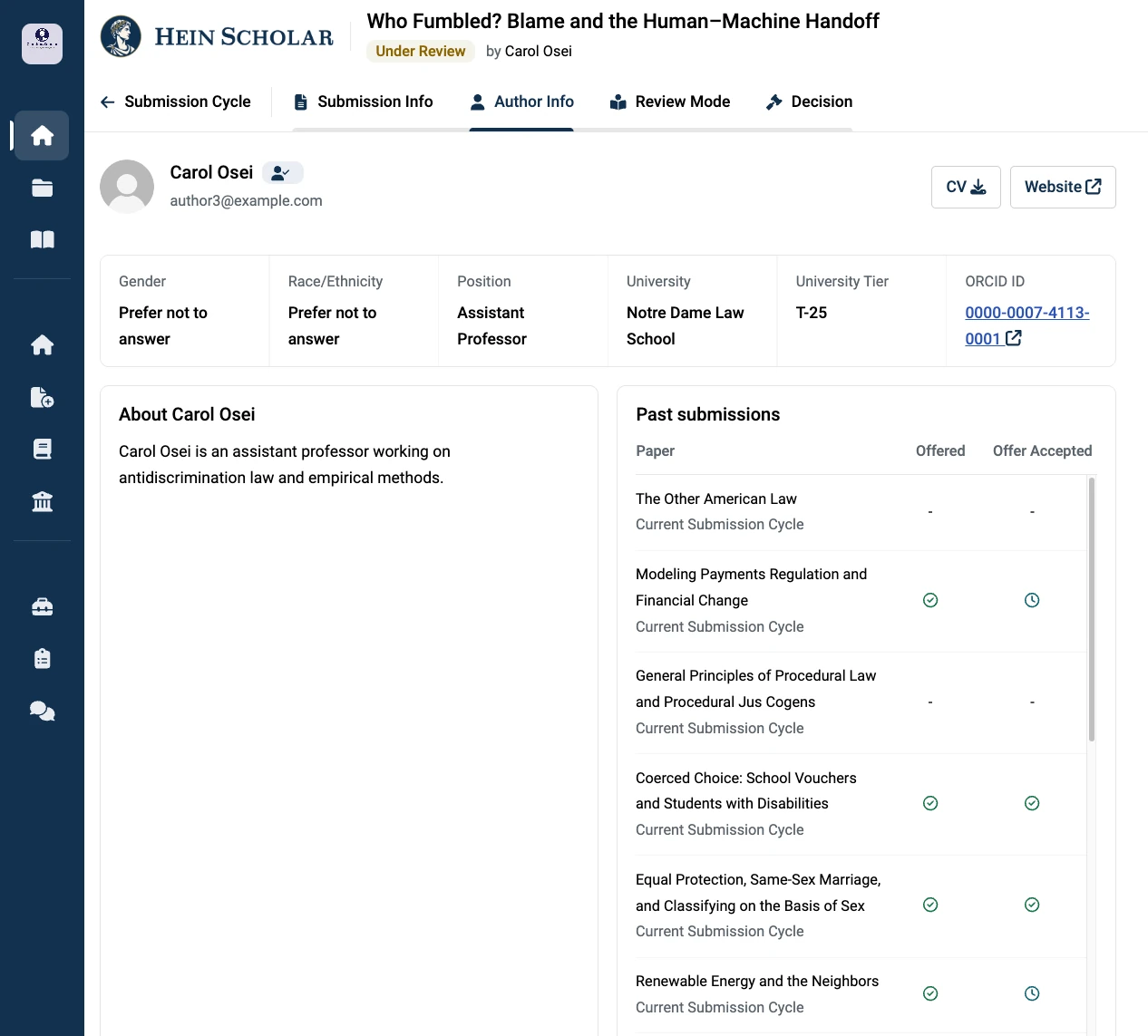
Author history
Past submissions, offers made and offers accepted stay with the journal, not with the editor who graduates.
Author chat
Message the author from the submission and keep the conversation on record.
04 · Research tools
Research tools backed by HeinOnline.
Three tools for editors and authors alike, available whenever you need them, not only inside a review.
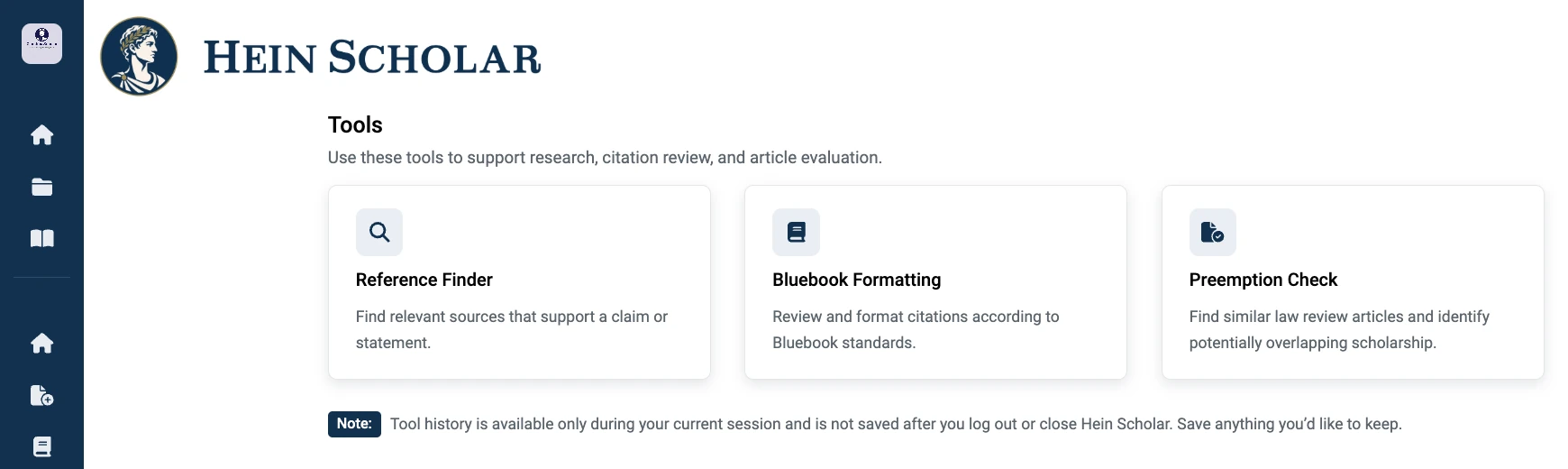
Reference Finder
Find relevant sources that support a claim or statement.
Bluebook Formatting
Review and format citations according to Bluebook standards.
Preemption Check
Find similar law review articles and identify potentially overlapping scholarship.
05 · For authors
Submit once. Know where it stands.
Authors get the same tools editors rely on, and a process they can see into, from the first preemption check to offers verified on the platform.
✓
Run a Preemption Check before you submit
✓
Submit once, in five steps, to every journal on your list
✓
Track every submission, review and offer in one place
✓
Funded by your school’s credits, or top up your own
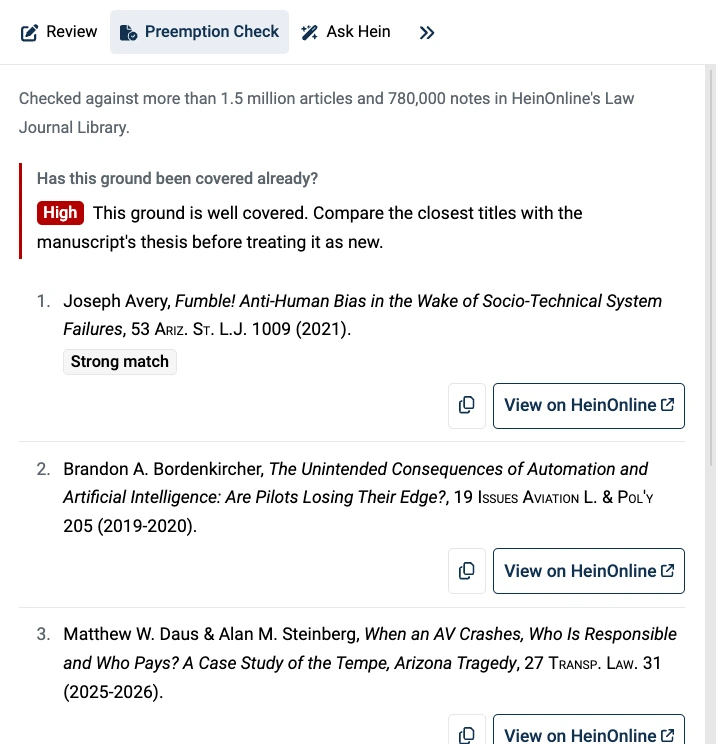
Authors see the same Preemption Check that editors do.
Compared
Side by side, it isn’t close.
Twelve differences between the per-submission platforms most law reviews use today and Hein Scholar, grouped by who feels them.
Preemption check
–
Today: by hand, if at all
1.5M+
published articles every manuscript is checked against, automatically, the moment it arrives.
Competing offers
–
Today: taken on the author’s word
Verified
Each offer and its expiration is recorded by the journal that made it, for every journal to see.
Paying for submissions
–
Today: $7.35 per journal, per submission
Flat rate
One annual school subscription, one invoice, credits for every author. Journals never pay.
What changes
The current model
Per-submission platforms

Free for every journal
For editorial boards
6 differences
Submission triage
–
One pile, every cycle
Submissions from every season land in the same undifferentiated list.
✓
A folder for every cycle
Sort and filter by status, field of law, rating or editor, with new arrivals flagged.
Preemption check
–
Left to the author, by hand
Editors can’t see what has already been written without searching for themselves.
✓
Automatic, on arrival
Every manuscript checked against 1.5M+ articles and 780K notes in HeinOnline’s Law Journal Library.
Reading and review
–
Download, then work elsewhere
Manuscripts scatter across Word files, email threads and shared drives.
✓
Review Mode, in the browser
Read, rate, annotate and discuss every paper in one place.
AI assistance
–
None
No summaries, no keywords, no way to question the text.
✓
On every submission
An AI summary, keywords and word counts, plus Ask Hein for questions about the text.
Competing offers
–
Taken on the author’s word
Expedite requests arrive as emails no one can verify.
✓
Verified on the platform
Each journal’s decision, the best offer and its expiration, recorded by the journals themselves.
Institutional memory
–
Graduates with the board
Each spring, what the board knew about its authors walks out the door.
✓
Kept by the journal
Past submissions, offers and acceptances stay on record for next year’s board.
For authors
3 differences
Before you submit
–
Search what you can reach
Authors are told to run their own preemption check across whatever databases they have.
✓
The same check editors run
A coverage rating and the closest published titles, while there’s still time to revise.
Expedite requests
–
Forward the offer by email
Then hope every journal on your list takes your word for it.
✓
Offers speak for themselves
An offer made on Hein Scholar is verified for the other journals still reading your piece.
Cost to submit
–
$7.35 per journal, per submission
$367.50 to send one article to 50 journals, before any reimbursement.
✓
Funded by your school
Submit on credits your school allocates, and top up yourself only if you need to.
For the law school
3 differences
Pricing model
–
Metered, per submission
The bill grows with every journal on every author’s list.
✓
One flat annual rate
Tiers sized to your school, so the cost is known before the season starts.
Paying for it
–
Fees, author by author
Authors pay up front and seek reimbursement, often only up to a cap.
✓
One invoice
Credits allocated up front, with nothing to reimburse.
Built for
–
Academic publishing in general
Law reviews are one segment of a much broader platform.
✓
Law reviews, only
Every feature is designed around the law review season.
“The current model” describes the per-submission platforms most law reviews use today, as of 2026. Costs shown at $7.35 per journal, per submission.

See it with your journal’s own workflow.
A short walkthrough, tailored to how your board reviews, rates and decides.