
Why Hein Scholar
Built for the whole law school.
The law school decides, the law review runs the season and authors do the submitting. Hein Scholar is designed so all three come out ahead: one predictable subscription for the school, free for every journal, and a transparent process for every author.
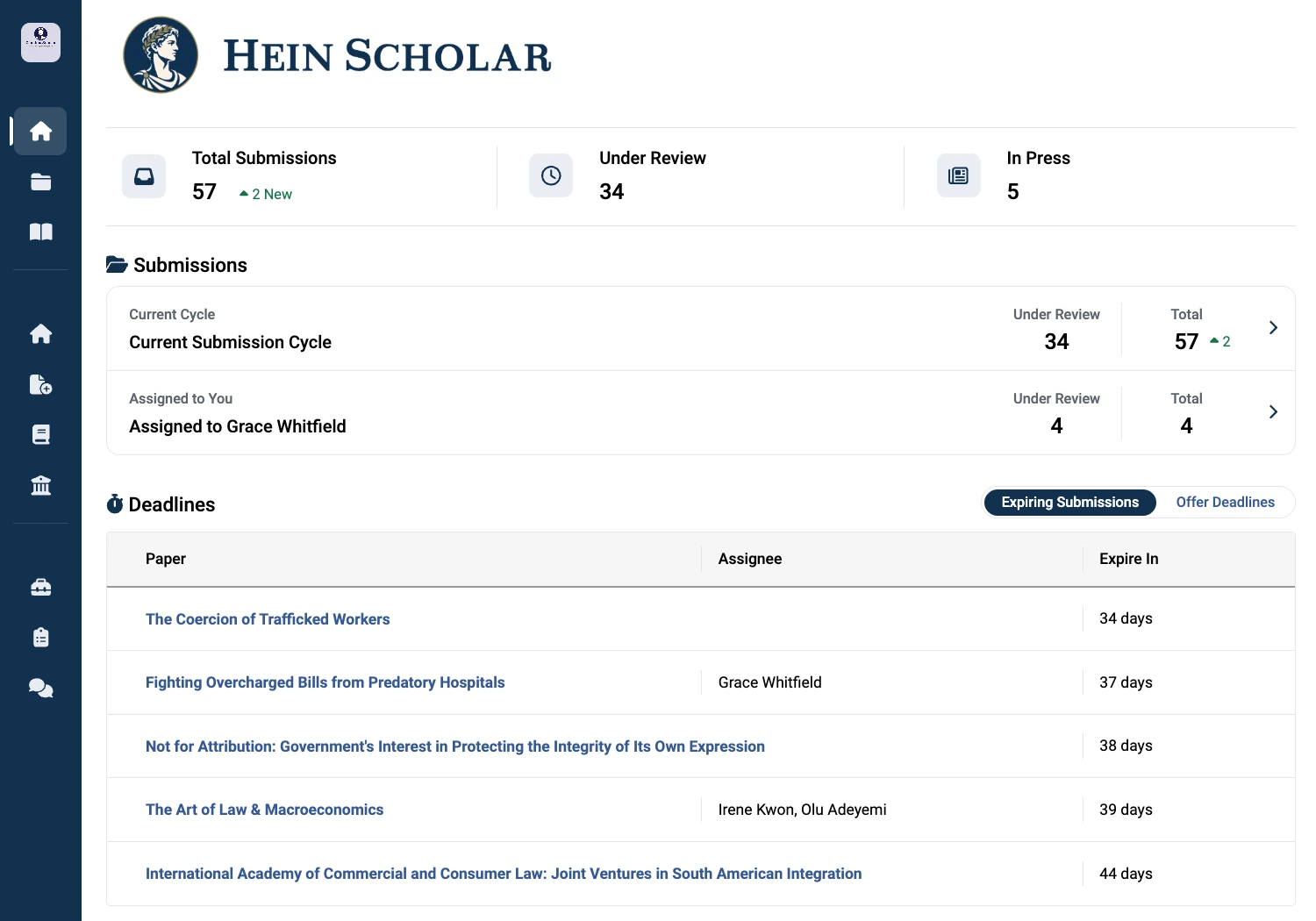
For law schools
One subscription replaces a stack of reimbursements.
The law school usually decides which platform its law reviews use, through the dean’s office, the journals’ faculty advisers or the law library. Here is what changes for the institution.
Budget
A flat rate you can plan around.
Choose a subscription tier sized to your school and know the cost before the season starts, not after the reimbursement claims arrive.
Billing
One invoice for the whole school.
Author submissions are funded up front on a single institutional invoice. No one processes per-submission reimbursements, faculty member by faculty member.
Control
Credits you allocate.
Apportion submission credits to your authors however your school prefers. An author who uses their allocation can top up on their own.
Journals
Free for your law reviews.
Every journal at your school uses the full platform at no cost, now and later. The subscription funds authors; it never moves the cost onto the journal.
Today
Paying per submission
–
Authors pay a fee for every journal, on every submission
–
Each author files for reimbursement, often only up to a cap
–
Costs grow with every journal on every list
–
The total isn’t known until the season is over
With Hein Scholar
One institutional subscription
✓
A flat annual rate, in tiers sized to your school
✓
Credits allocated to authors up front
✓
One invoice, and nothing to reimburse
✓
Free for every journal, always
For editorial boards
Spend the season reading, not wrangling.
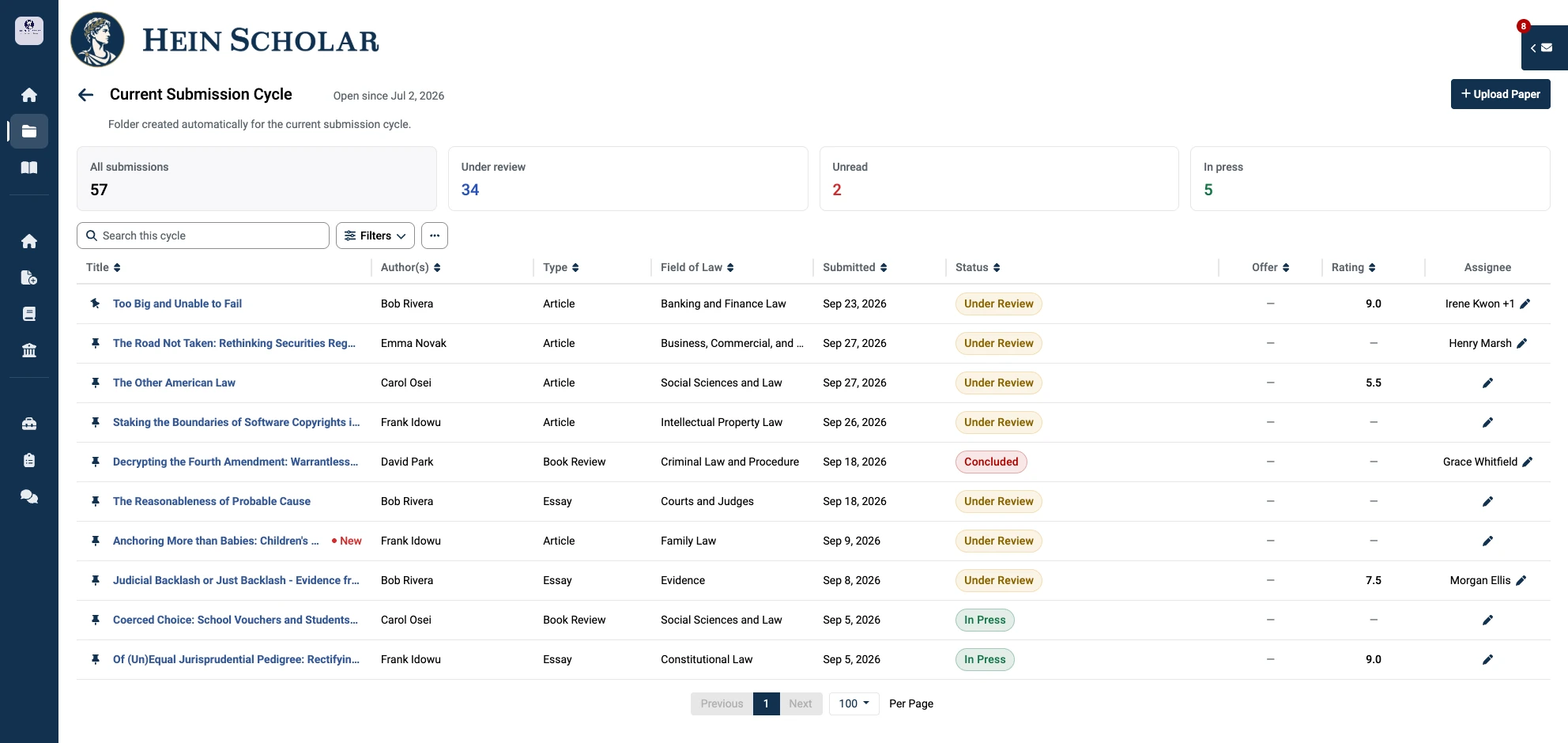
Your board turns over every year; the submission volume does not. Hein Scholar gives each new board the same workflow, the same screening tools and the same record of what came before, at no cost to the journal.
✓
Every manuscript arrives with its Preemption Check attached
✓
A folder for every cycle, with filters, ratings and assignments
✓
Offers and declines sent from the paper, with the author notified
✓
Author history that outlasts the board
1
Before the window
Configure once.
Set your journal’s description, submission criteria and decision templates a single time. They belong to the journal, so next year’s board inherits them instead of rebuilding them.
2
During the surge
Screen on arrival.
Manuscripts land with a preemption result already attached, so the first screening question is answered before anyone opens the file.
3
After decisions
Keep the record.
Correspondence, notes and outcomes stay on the journal’s record rather than in a departing editor’s inbox, ready for whoever takes over in the spring.
For authors
Transparency, from first check to final offer.
Authors go where the journals are. Once those journals are on Hein Scholar, the process opens up: you can check your manuscript against the literature before you send it, and your offers are verified on the platform instead of taken on trust.
✓
Offers verified on the platform, not forwarded by email
✓
Every offer in one place, ready to accept or decline
✓
The same Preemption Check editors see, before you submit
✓
Submit once, in five steps, to every journal on your list
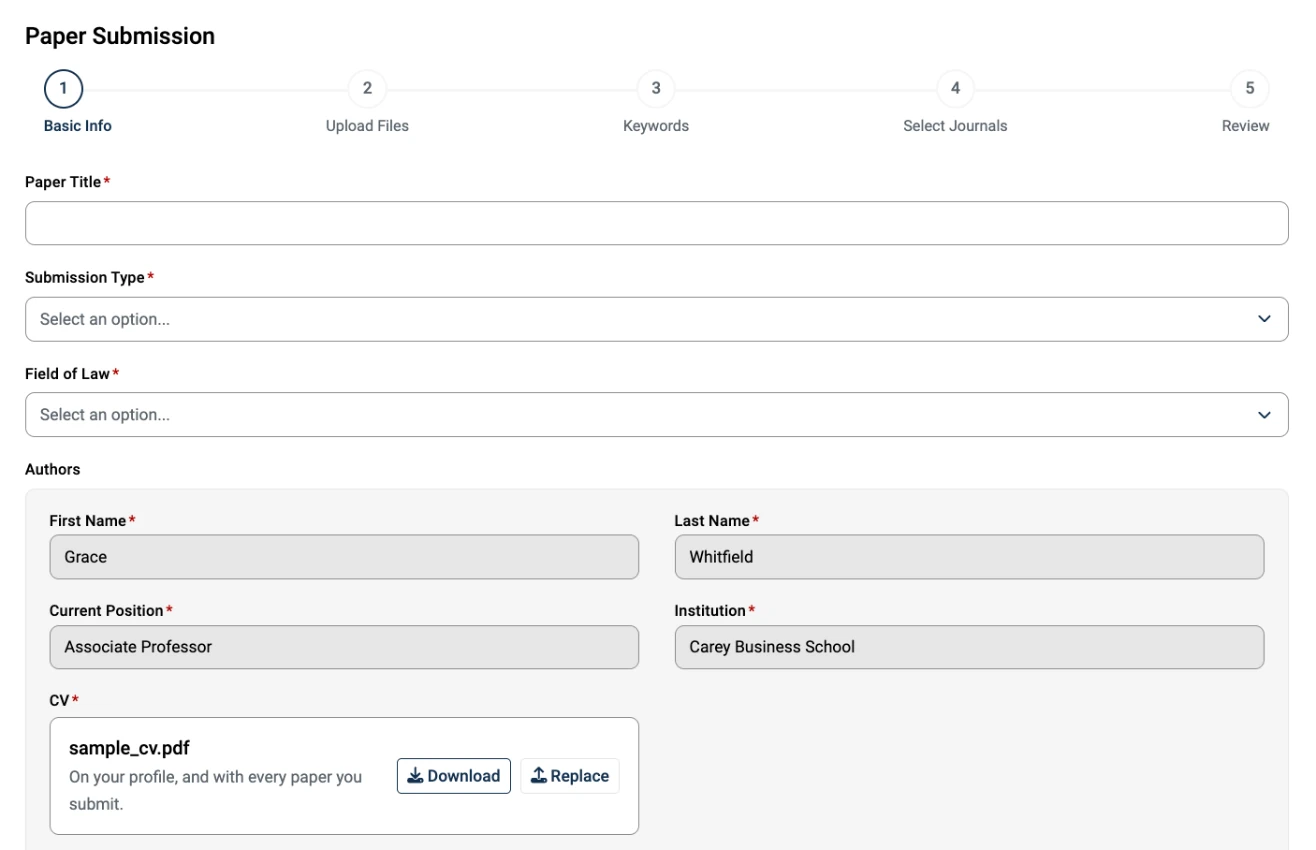
Transparency
Offers on the record.
Each offer and its expiration is recorded by the journal that made it, so an expedite request rests on verified facts, not a forwarded email.
Fairness
The same check, both sides.
You run the Preemption Check before you submit; boards run it when the manuscript arrives. Neither result is hidden from the other side.
Cost
Funded by your school.
Submit with the credits your law school allocates. If they run out, or your school hasn’t subscribed yet, you can add your own.
Who signs off
Four people weigh in on a platform change. Each asks something different.
A switch usually needs the dean’s office, the faculty adviser, the law library and the editor-in-chief on the same page. Here is what each tends to ask first.
The dean’s office
“What will it cost us?”
A flat annual subscription in tiers, on one invoice, with nothing to reimburse. Journals never pay.
The faculty adviser
“What happens to the record?”
Decisions, notes, correspondence and author history stay with the journal, so every incoming board starts with the full picture.
The law library
“Who stands behind it?”
William S. Hein & Co., the company behind HeinOnline. Its Law Journal Library powers every Preemption Check.
The editor-in-chief
“Does it hold up in February?”
Season folders, filters and ratings keep the surge sorted, and every manuscript arrives with its preemption result attached.
Making the switch
How a law school moves to Hein Scholar.
Three steps. None of them asks a journal to pay, or a board to re-key a season of records.
1
The school subscribes.
Choose a tier and allocate credits to your authors. One agreement, one invoice.
2
Journals move in.
Each law review sets up its journal once. Existing records come across as part of onboarding, at no cost to the journal.
3
Authors submit.
Faculty submit with the credits you allocated, and can add their own if they need more.
Questions we hear
Answered plainly.
Questions about cost? The pricing page covers how the institutional subscription and author credits work.
What happens to our existing submissions and records?
+
Migration is handled as part of onboarding. Existing submission history and editorial records come across with the journal; no board is asked to re-key a season’s worth of data in order to switch.
Our board changes completely every year. How much retraining is that?
+
The workflow is identical for every incoming board and the journal’s configuration persists through the handover. Annual turnover is the assumption the product is built on, not an exception it has to accommodate.
Can our journals still run their own screening process?
+
Yes. A preemption result is information attached to a manuscript, not a decision about it. Each board’s criteria, reading order and voting process remain entirely its own.
Can authors still submit to journals that aren’t on Hein Scholar?
+
Yes. Hein Scholar covers the journals that use it; it doesn’t lock anyone out of anything else. For many authors the first season is a mix.
How current and how deep is the preemption corpus?
+
It runs against HeinOnline’s Law Journal Library: more than 1.5 million articles and 780,000 notes across 3,500+ journal titles, every title digitized back to its first issue.

Bring Hein Scholar to your law school.
Fifteen minutes with your dean’s office, library or law review. We’ll walk through the platform and how a subscription would work for your school.