
You asked. We built it.
Introducing Hein Scholar.
A new standard for law review submissions.
Hein has been your source for published legal scholarship for more than 100 years, representing work from 3,500+ journals. Now we're bringing the publication cycle full circle.
Who it’s for
One platform for the whole law school.
For law schools
Back your scholarship, not the paperwork.
Designed with the academic law community in mind, Hein Scholar offers an affordable way to support your journals and faculty while managing roles, responsibilities, and funds.
For editorial boards
Simplify the work behind every editorial decision.
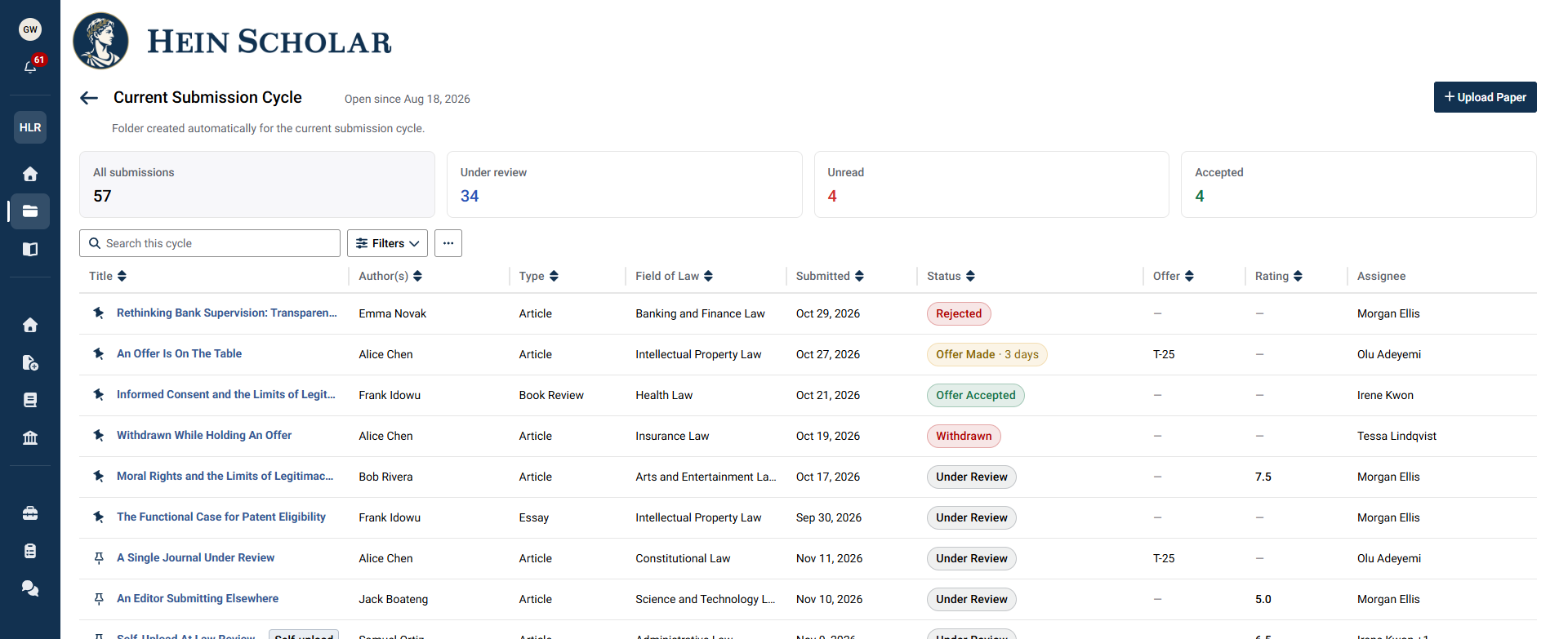
Manage an entire submission cycle from one centralized table, quickly review preemption results, and leave next year’s editorial board a complete record. Free for every journal.
For authors
Transparency, from first check to final offer.
Check your manuscript against the Law Journal Library before you send it, easily submit to every journal on your list, and let verified offers speak for themselves.
Compared
Side by side, it isn’t close.
Ten differences between the per-submission platforms most law reviews use today and Hein Scholar, grouped by who feels them.
What changes
The current model
Per-submission platforms

Built for the academic law community.
For editorial boards
4 differences
Submission triage
–
One pile, every cycle
Editors must manually organize submissions by cycle using filters or tags.
✓
A folder for every cycle
Automatically organized by cycle, with easy filtering and new arrivals flagged.
Preemption check
–
A separate research step
Editors must independently research whether similar scholarship has already been published.
✓
Built into the workflow
Every manuscript checked against 2.6M+ articles in HeinOnline’s Law Journal Library.
Collaborative manuscript review
–
Disconnected review process
Editors can read, rate, and discuss manuscripts, but in-text annotations and collaborative review often require separate tools.
✓
Review together, all in one place
Forget Google Docs. With Hein Scholar, editors can highlight, add in-text annotations, comment, rate, and assign tasks directly within manuscripts, all in one place.
Competing offers
–
Taken on the author’s word
Editors rely on authors to communicate competing offers and deadlines.
✓
Verified on the platform
Offers and expiration dates are recorded directly in Hein Scholar, providing greater transparency.
For authors
3 differences
Before you submit
–
Research on your own
Authors independently search for similar scholarship before submitting their manuscripts.
✓
Explore related scholarship
Identify similar published articles and assess your manuscript's originality before submitting.
Expedite requests
–
Self-reported offers
Authors request expedited reviews by communicating competing offers and deadlines.
✓
Offers speak for themselves
Your offers are automatically verified, giving other journals reviewing your manuscript confidence to act on your expedite requests.
Cost to submit
–
$7.35 per journal, per submission
$367.50 to send one article to 50 journals.
✓
Affordability in mind
Designed to make law review submissions more accessible and affordable for authors, without the burden of high per-submission costs.
For the law school
3 differences
Managing submission costs
–
Pay per submission
Costs increase with each additional journal selected by an author.
✓
A more predictable approach
Designed to help institutions better plan for and manage law review submission expenses.
Institutional management
–
Separate accounts for different groups
Institutions can create and manage separate accounts to independently sponsor students and faculty.
✓
One account. Complete control.
Manage students and faculty in one place, with the ability to invite users or approve and decline requests for institutional funding.
Built for
–
Academic publishing broadly
Law reviews are one part of a platform serving multiple academic disciplines.
✓
Built for law reviews
Purpose-built for the unique needs of law review authors, editors, and institutions.
“The current model” describes the per-submission platforms most law reviews use today, as of 2026. Costs shown at $7.35 per journal, per submission.

See Hein Scholar with your journal’s own workflow.
A short walkthrough, tailored to how your board reviews, rates and decides.